


First Time Home Buyer Programs in California: Your 2027 Guide

You may need less money down than you think
The biggest thing stopping most first-time buyers in the Central Valley is not the monthly payment. It is the down payment. The good news: California has more help for first-time buyers than almost any other state, and some of it never has to be paid back while you live in the home.
This guide walks through the state programs and the federal loan options that can lower the cash you need to buy. You will also learn who qualifies and the exact steps to get started in 2027.
Do you count as a first-time home buyer?
Probably, even if you have owned a home before. Most programs define a first-time buyer as someone who has not owned a home they lived in during the last three years. So if you sold a house five years ago and have been renting since, you likely still qualify.
A few programs add extra rules:
- Income limits based on your county and household size
- Homebuyer education, usually a short online class
- Primary residence only, meaning you have to live in the home
- First-generation buyer rules for some programs, like Dream For All, where your parents also cannot currently own a home
If you are not sure where you land, a quick conversation with a loan officer can sort it out in a few minutes.
California state programs (CalHFA)
The California Housing Finance Agency, or CalHFA, runs the biggest statewide programs. They work through approved lenders, so you apply with a loan officer, not directly with the state.
| Program | What it gives you | Good to know |
|---|---|---|
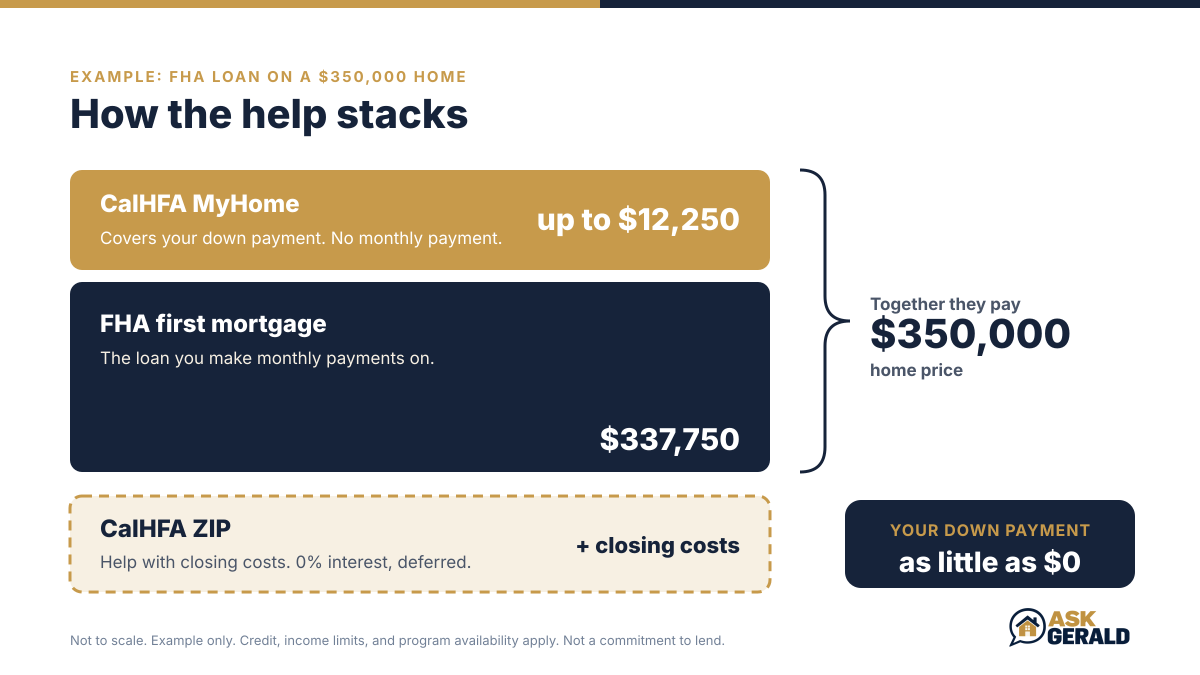
| MyHome Assistance | Up to 3.5% of the price with an FHA loan, or 3% with a conventional loan, for down payment or closing costs | No monthly payment. It is a deferred loan paid back when you sell, refinance, or pay off the home. Must be paired with a CalHFA first mortgage. |
| Zero Interest Program (ZIP) | Extra help for closing costs | 0% interest and deferred. Can be stacked with MyHome. |
| California Dream For All | Up to 20% of the price, capped at $150,000 | Shared appreciation: when you sell, you repay the loan plus a share of the home’s gain. For first-generation buyers. Awarded by lottery during short application windows. |
Low and no down payment loans
These are the loan types most first-time buyers use. The state programs above sit on top of them.
| Loan | Minimum down | Best for |
|---|---|---|
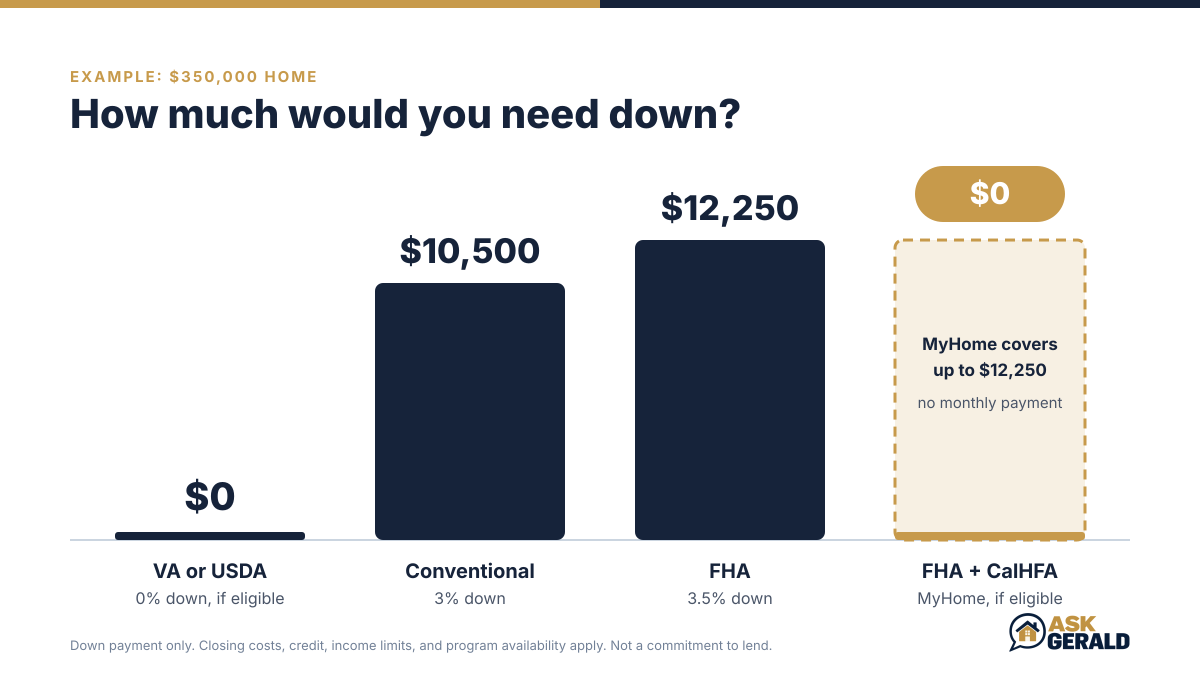
| FHA | 3.5% | Buyers rebuilding credit or with smaller savings |
| Conventional (first-time buyer options) | 3% | Buyers with solid credit who want to drop mortgage insurance later |
| VA | 0% | Veterans, active-duty service members, and eligible surviving spouses |
| USDA | 0% | Buyers in eligible rural and small-town areas who meet income limits |
The Central Valley USDA advantage: Eligibility is set by address, so ask Gerald if the home you’re looking at is on the USDA eligibility map.
Veterans: a VA loan is usually the strongest option if you qualify. No down payment, no monthly mortgage insurance, and it can also be paired with CalHFA help for closing costs.
How do I get started?
- 1Get your personalized Homebuying Blueprint. Gerald helps you understand where you stand with credit, income, and savings. Together, you’ll map out your next steps, whether that’s exploring loan and assistance options now or building a plan to get ready.
- 2Get preapproved when you’re ready. Gerald walks you through the application and documents so you can shop with a clearer sense of your price range and estimated costs.
- 3Find your home and make an offer. Work with your real estate agent to find a home you love. Gerald can help you understand what the numbers look like for that specific property before you make an offer.
- 4Finalize your loan and get the keys. Once your offer is accepted, Gerald guides you through the remaining loan steps and helps you prepare for closing day.
Frequently asked questions
What are first time home buyer grants in California?
Most California help is a deferred loan, not a true grant. That means no monthly payment, but you repay it when you sell or refinance. Some lender and local programs do offer grants that never have to be repaid.
How much do I need for a down payment in California?
As little as 0% with VA or USDA, 3% with conventional, or 3.5% with FHA. Assistance programs can cover part or all of that.
Can I combine more than one program?
Often, yes. For example, an FHA loan can be paired with CalHFA MyHome for the down payment and ZIP for closing costs.
What credit score do I need?
It depends on the loan and program. FHA is the most flexible, and many state programs work with scores in the 600s.
Is there an income limit?
For most assistance programs, yes. Limits are based on your county and household size. FHA, VA, and conventional loans themselves have no income limit.
Not sure which program fits you?
Ask Gerald.
Every buyer’s situation is different, and programs open and close throughout the year. Gerald helps Central Valley families from Visalia to Fresno find the programs they actually qualify for, then puts together a plan to get them into a home.
Ask Gerald at askgeraldnow.com →
Call or text Gerald Hayes: 559-634-1022
Equal Housing Opportunity. Gerald Hayes, Mortgage Consultant, NMLS #283054 (nmlsconsumeraccess.org). Vero Mortgage is a division of Golden Empire Mortgage. NMLS# 2427. Vero Mortgage is licensed by the Department of Financial Protection and Innovation under the California Residential Mortgage Lending Act, NMLS 2427. Applicants are subject to credit and underwriting approval. Not all applicants will be approved for financing. Receipt of application does not represent an approval for financing or interest rate guarantee. Refinancing your mortgage may increase costs over the term of your loan. Restrictions may apply. Savings, if any, vary based on the consumer’s credit profile, interest rate availability, and other factors. Program details, availability, and income limits are subject to change.
Sources